
About The Patrons

Chandni Joshi
Chandni Joshi is one of Nepal's most accomplished gender, rights, and public policy specialists, with more than five decades of distinguished service at the national, regional, and international levels. Her career has been dedicated to advancing gender equality, women's economic empowerment, inclusive development, and evidence-based policymaking.
She began her public service career with the Government of Nepal, serving as Joint Secretary and Chief of the Women Development Programme. During this period, she initiated the pioneering Production Credit for Rural Women (PCRW) Programme, Nepal's first national programme focused on the economic empowerment of rural women. Her work laid an important foundation for integrating gender perspectives into national development planning and public policy.
In 1990, Ms. Joshi established the UNIFEM South Asia Regional Office and served as its Regional Director for 18 years. Under her leadership, the office evolved into a leading knowledge-based institution, supporting innovative programmes that promoted women's rights, gender-responsive governance, and the empowerment of marginalized and excluded women across South Asia. She has also made significant contributions to advancing gender-responsive budgeting throughout the region.
In recognition of her expertise and lifelong commitment to public service, the Government of Nepal appointed her as the Coordinator of the Think Tank of the Ministry of Women, Children and Social Welfare in 2017. She currently serves as the Senior National Advisor to UN Women Nepal, where she continues to provide strategic guidance on gender equality and inclusive development.
Ms. Joshi's outstanding contributions have been recognized through numerous national and international honours, including the Lifetime Achievement Award conferred by the President of Nepal in 2009.
As Patron of FIPMO, Chandni Joshi provides strategic guidance and inspiration to the organization. Drawing on her extensive experience in government and the United Nations system, she continues to strengthen FIPMO's mission of bringing together former international professionals to contribute to Nepal's development through knowledge, experience, and policy engagement.
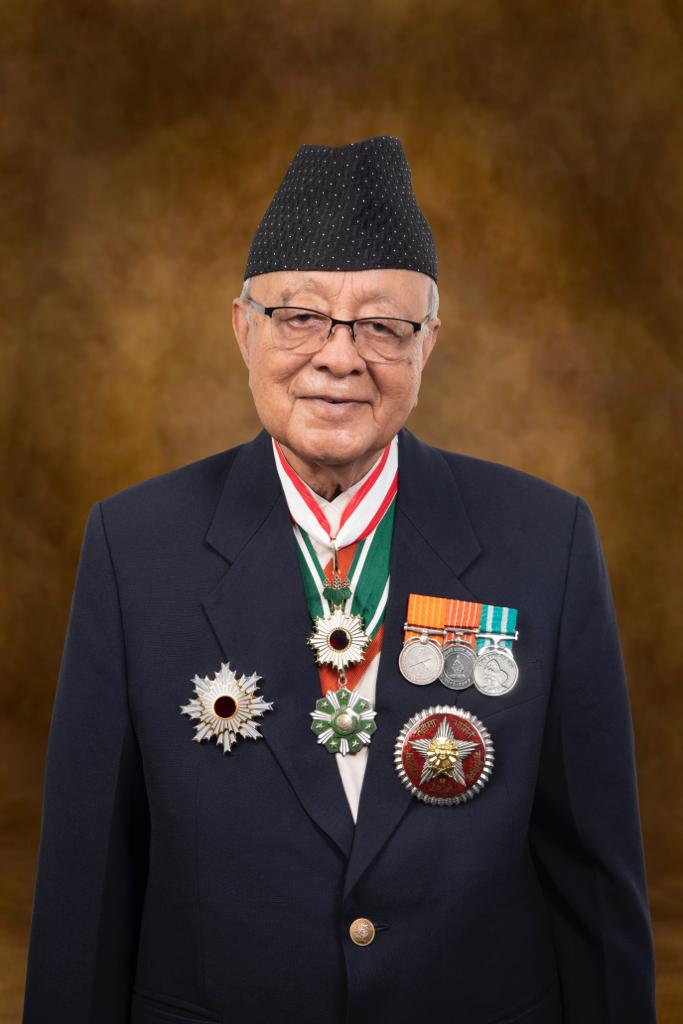
Late Himalaya Shumsher Rana
Late Himalaya Shumsher Rana was one of Nepal's most distinguished public servants, financial leaders, and international civil servants. Widely regarded as a pioneer of Nepal's modern financial system, he played a transformative role in strengthening the country's economic and financial institutions during the early years of democratic Nepal.
As Nepal's first Finance Secretary, he introduced several key institutional reforms, including the establishment of the Department of Customs, the Office of the Auditor General, and the practice of presenting the national budget. He also oversaw the issuance of Nepal's modern banknotes.
In 1957, he became the first Governor of Nepal Rastra Bank, where he led the transition to the Nepali rupee as the country's sole legal tender and established the fixed exchange rate between the Nepali and Indian rupees, providing long-term monetary stability that continues to underpin Nepal's financial system.
Following his public service in Nepal, Mr. Rana pursued a distinguished international career with the United Nations, serving in Sri Lanka, Afghanistan, and Pakistan for nearly four decades. His extensive experience in international development, governance, and public administration earned him widespread respect both within Nepal and abroad.
After returning to Nepal, he continued contributing to the country's financial sector by establishing Himalayan Bank in partnership with Habib Bank and remained actively involved in strengthening Nepal's banking industry. He also played important roles in promoting private sector development and fostering dialogue during periods of national transition.
As FIPMO's Founding Patron, Late Himalaya Shumsher Rana provided invaluable guidance, credibility, and inspiration to the organization. His lifelong commitment to professionalism, institution building, democratic values, and international cooperation continues to serve as a guiding example for FIPMO and its members.